Peel Ports Group CEO on the benefits of the "Port to Project" approach
22 October 2026
Peel Ports Group Chief Executive Officer David Huck commented on 1 October that:
Despite being tasked with an ambitious pipeline of projects, the construction industry is seemingly struggling to overcome a combination of hurdles, from higher material costs to skills shortages...
His observation was part of Peel Ports Group’s wider statement in anticipation of prime minister Andy Burnham’s first budget – against the backdrop of the government’s planned council housebuilding programme and pipeline of major projects. The statement also noted that figures from the Office for National Statistics show construction output fell across April, May and June this year, with new orders down 11.8% quarter-on-quarter.
In the statement Huck went on to emphasise that 'an obvious place to start' in terms of overcoming cost and efficiency challenges is the movement of construction materials into and around the country.
Talking to NCE, he contends that developments in the construction market are necessitating change – with structural transformation, high energy costs, carbon taxation, cheaper imports and labour shortages among the drivers.
We’ve seen a lot of consolidation, particularly in the aggregate and cement markets. We’ve seen a transition to more imported cargo as domestic policy has meant that we have shut down a lot of domestic production, primarily of cement. And we’ve also seen more aggregate move by marine around the UK. Those have been the fundamental shifts over the last five years.
Port-to-project
Such shifts now mean ports should play a more pivotal role in the success of UK infrastructure projects, he says.
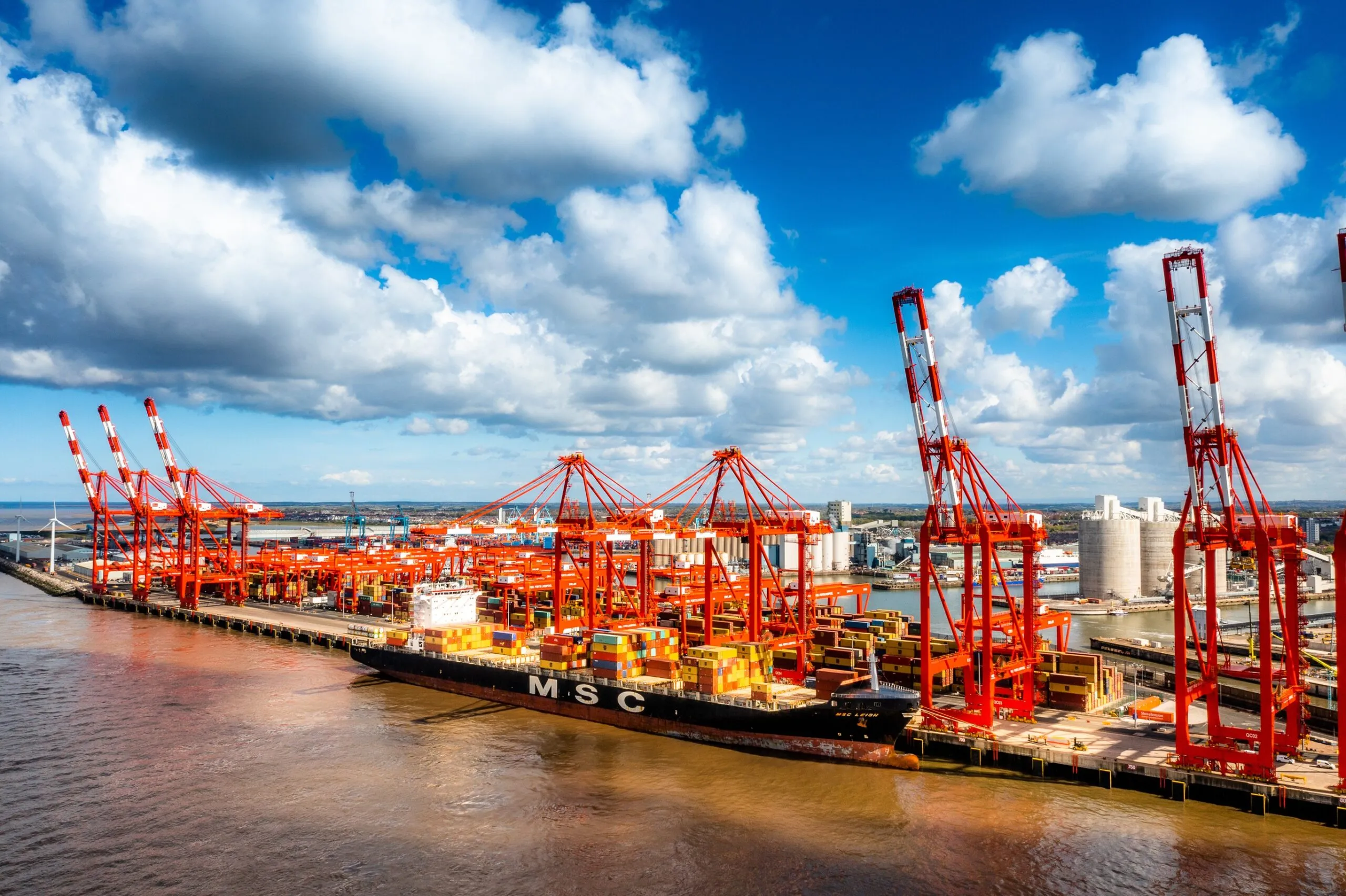
Peel Ports Group (Peel Ports) has a horse in this race as the second-largest port group in the UK, handling over 70M.t of cargo annually. It covers seven statutory port authorities: Port of Liverpool, Manchester Ship Canal, River Medway (London Medway / Sheerness Harbour), Clydeport (parts of the area along and around the River Clyde), Ardrossan Harbour on the Firth of Clyde, Twelve Quays at Birkenhead Docks in Merseyside, and Heysham Port in Lancashire.
The geographic spread and facilities offered by its portfolio have led to a natural intersection with major schemes and construction more generally, Huck says:
One of our key strategies moving forward is working primarily with the construction sector, developing a construction sector ecosystem.
The adoption of 'port-to-project' thinking over the past five or six years plays a key role here. The approach is designed for the delivery of time-sensitive cargo – for example oversized, heavy-lift, high-value infrastructure components such as wind turbines, solar panels or materials such as cement, concrete, steel and timber – directly to site.
To support this, the group has been implementing a 'virtual construction' ecosystem, transforming sites across its port estates into 'virtual quarries' which act as port-centric consolidation and processing hubs for building materials.
“We’ve partnered with several of the big players in aggregates and cement and in essence, our strategy has been to develop an ecosystem in line with some of the large infrastructure projects that require deep water and land for storage.
Choosing a deep water, port-centric virtual quarry as opposed to traditional modes can take a significant amount of cost out of the construction supply chain, because you’re cutting out the cost, carbon and congestion in the construction supply chain by bringing everything to a port where you have the whole ecosystem. So you get the economies of scale advantage of significant tonnage parcels, which you can then distribute onward to the project door.
There are plans to refine this proposition further.
Where I’d like to see the business go forward is partnering more for batching, for concrete casting and so on whereby – rather than bringing everything inland – you can do it all in the port.
Sustainability and renewal
Huck notes that decarbonisation is central to the focus on supply chain flow, with Peel Ports having pledged to achieve net zero operations by 2040.
In December – the same month as it became the first UK port operator to join the Construction Leadership Council’s Co2nstructZero programme – the group launched its Sustainable Construction Partner programme to formalise links between materials and logistics suppliers such as Ecocem, Holcim, and Hercules and end users.
Alongside bringing sustainable materials closer to the point of use, the partnership will allow large volumes of materials to move cost-effectively by rail or water, supporting government targets to shift freight to lower-carbon transport,” says Huck.
The programme’s pilot hub at the Port of London Medway supports schemes including the Lower Thames Crossing. It allows heavy, high-volume construction materials to be stockpiled and transported sustainably via water or rail instead of relying strictly on heavy goods vehicles (HGVs).
More broadly, the group is supporting a range of decarbonisation projects. Its North West assets including the Port of Liverpool are positioned at strategic locations to support the HyNet North West carbon capture, usage, and storage (CCUS) cluster, which uses carbon storage beneath Liverpool Bay.
It has also been engaged with Sizewell C nuclear power station, with the handling and offloading of shipments of construction aggregates and heavy building materials at the Port of Great Yarmouth. Since 2015, it has also supported Drax Power Station in North Yorkshire by operating a custom-built, £100M biomass import terminal at Gladstone Dock within the Port of Liverpool to process and transport sustainable wood pellets.
The group is also reviving some rail operations “to create a greener corridor from virtual port-based quarries”, he says. One such project is the Port of Warrington, a £350M multi-modal freight terminal scheme that revives plans to build a reinstated rail freight link directly to the West Coast Main Line.
Other sustainability wins include the installation of nearly 7,000 solar panels on the roof of Alexandra Dock warehouse at Port of Liverpool, wind turbines for electrical generation across the group’s portfolio and Archimedes Screw generators for power generation within the weirs at Manchester Ship Canal.
These initiatives align with Peel Ports’ long-term upgrade programme, much of which also underpins its construction sector strategy. In June 2025, the group awarded general and marine construction frameworks worth up to £750M and scheduled to run until 2033, with procurement embedding strict climate-conscious requirements into the selection process.
The scope of works covers general construction – drainage, roads, earthworks, rail, and warehouse maintenance/construction, and marine construction – piling, quay walls, and lock/sluice maintenance. Appointed partners included national and regional contractors such as Glencar, J Murphy & Sons, McLaughlin & Harvey, C Spencer, and A E Yates.
These civil and structural upgrades include redevelopment of roll-on/roll-off (RoRo) berths and heavy-lift terminals and the £100M expansion of national steel and metals multimodal hubs to ease gridlock on land networks, supported by infrastructure including road, rail and marine.
Shifting the dial
Huck believes the transformations taking place across the group’s estate are a clear demonstration that ports should be front-of-mind for the construction sector.
There’s a huge shift to importing because of decarbonisation and ports are going to play a pivotal role in the future of the construction sector. It’s transformational,
he says. And he indicates that, given the sector’s tendency to rely on tried-and-tested approaches, driving the message of what ports can do for infrastructure is an ongoing task.
It is like pushing an elephant up the stairs sometimes because you say, ‘Look, we can save you cost, carbon and congestion’ and you’ll hear – ‘But I’ve always had a small parcel of whatever go to whatever small port.’ And you say – ‘If you could ship in 10 times that quantity, this is the price you would pay, and you can take it just in time to your project’. At that point, procurement lights up and works out that there’s a huge price saving to be had from following a port-centric construction sector proposition.
When I talk to the supply chain, particularly the big players in the UK, they are realising more and more how important ports are to their logistics solution.
He adds:
Sometimes you need to rip up your traditional routes to projects and look at things through a different lens.
The construction sector often tends to work very hard, even too hard. But there is a smarter, better way.
To find out more about the Sustainable Construction Partners project, click here: